Wave fold and Ripplefold describe drapery that hangs in a repeating S-shaped pattern rather than forming individual sewn pleats. They look related, but the hardware and fabrication details are not automatically interchangeable.
The shared visual idea
Both systems create a continuous sequence of forward and backward folds. The result is modern, calm, and especially effective across wide window walls. The heading usually hangs directly below the track, which places more visual emphasis on the fabric and less on individual hooks or rings.
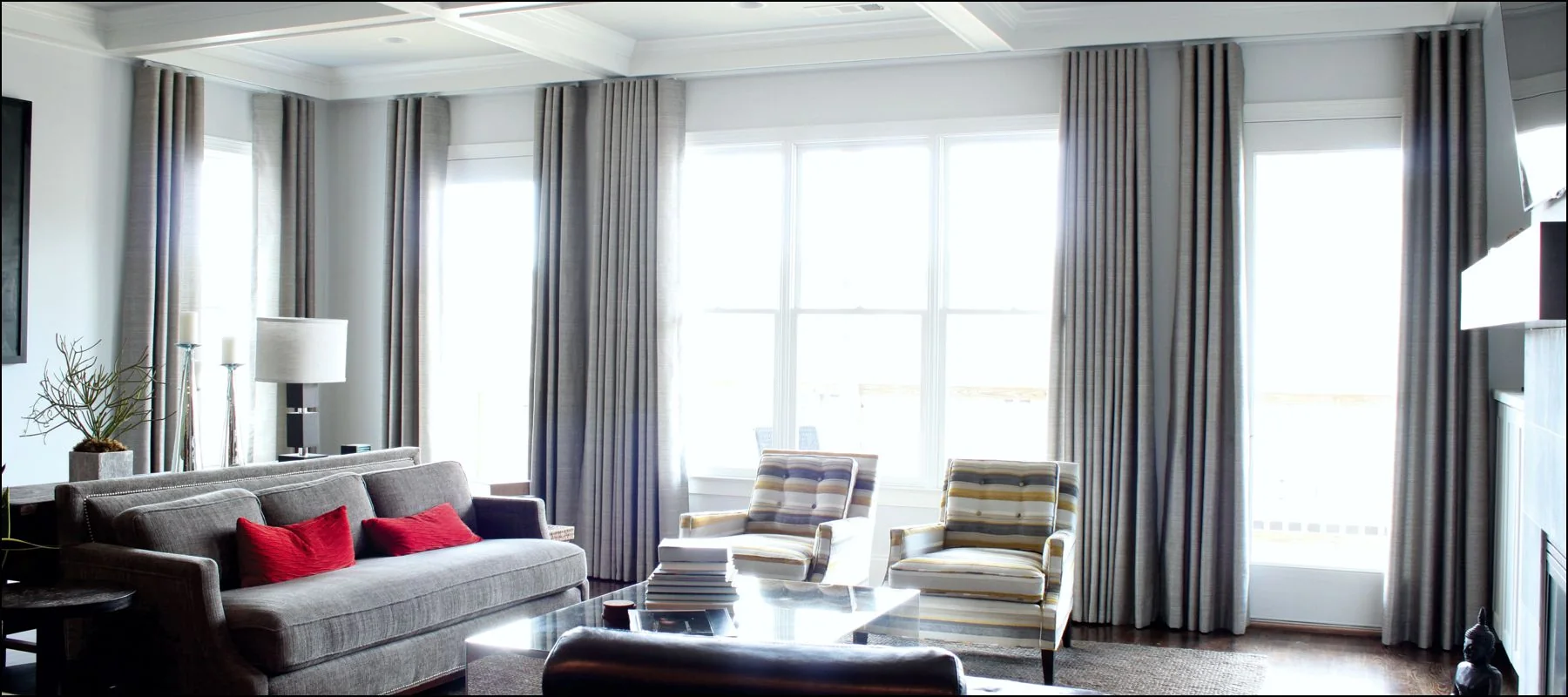
The practical difference
Ripplefold is a specific branded system associated with defined carrier spacing, snap tape, and fullness relationships. Wave fold is often used more broadly for continuous-fold systems made by different hardware manufacturers. Those systems may use different tapes, gliders, hooks, fullness percentages, and return components.
Because the terms are sometimes used casually, the workroom and hardware supplier should identify the exact track system before fabricating the panels.
Fullness and spacing
The depth and frequency of the folds are controlled by the relationship between the carrier spacing, the tape or hook spacing, and the amount of fabric. More fabric generally produces deeper folds and a larger stack. Less fabric produces a flatter, tighter pattern.
| Planning factor | Why it matters |
|---|---|
| Carrier spacing | Sets the rhythm of the folds along the track. |
| Fabric fullness | Controls fold depth, appearance, and stack size. |
| Return components | Shape the first and last fold near the wall or end cap. |
| Overlap or butt center | Determines how split panels meet at the center. |
| Fabric character | Stiffness, weight, and memory affect how cleanly the wave forms. |
Which should you specify?
Choose the system supported by the selected hardware and workroom. The most important issue is not the label alone. It is whether the track, carriers, tape, fabrication method, and project dimensions have been designed as one compatible assembly.
Need help specifying a system?
Send us the opening dimensions, photographs, heading style, and operation preference.
Contact Urban Decors